

Can you Conquer Mars? The Truth About Planting Flags in Space!

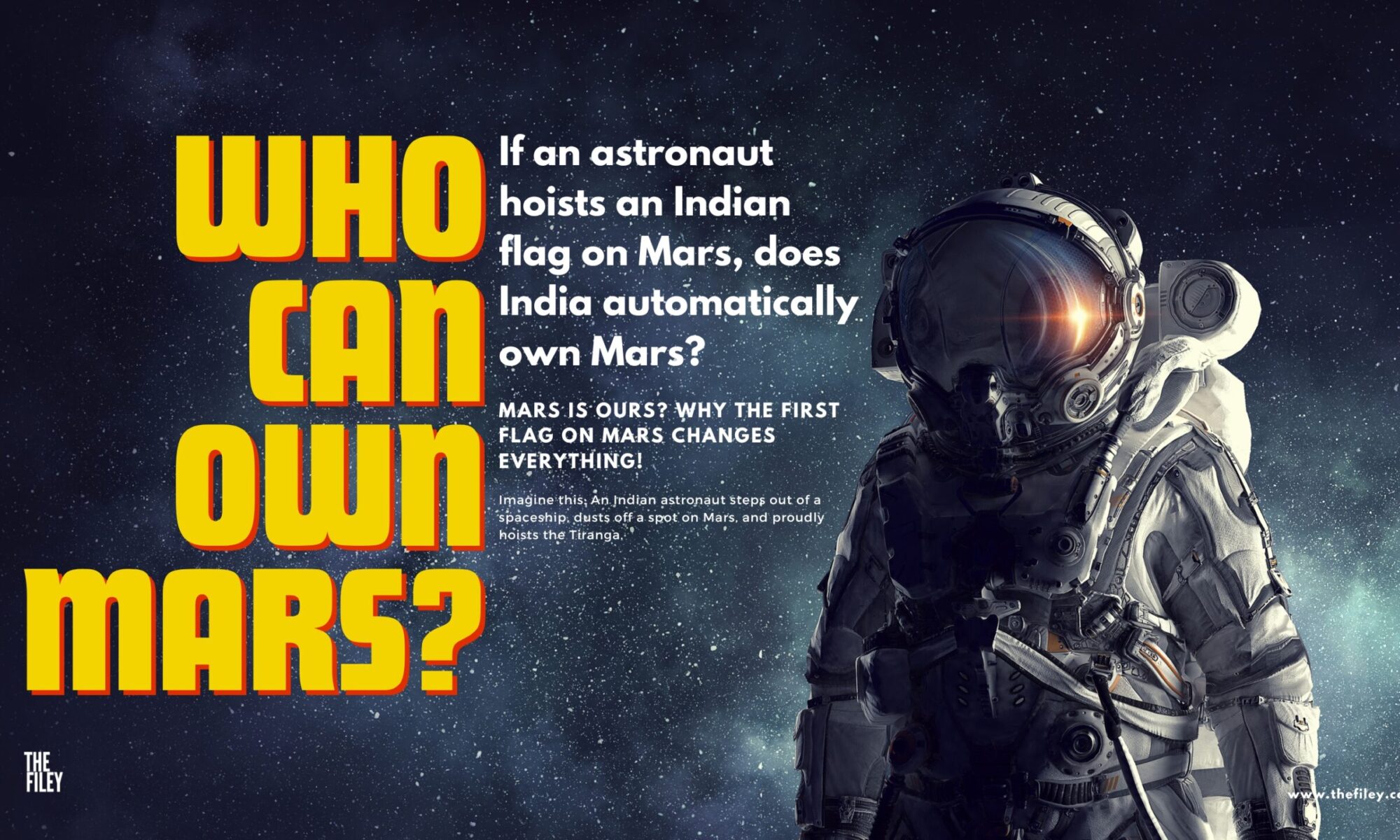
If an Astronaut Hoists an Indian Flag on Mars, Does India Own the Red Planet?

Imagine this: An Indian astronaut steps out of a spaceship, dusts off a spot on Mars, and proudly hoists the Tiranga. The world watches in awe. But wait—does this mean India just claimed Mars? Can a nation plant its flag on an alien world and call it its own, like some intergalactic land grab?

Before you start celebrating India’s Martian Empire, let’s break it down. But be warned—what you’re about to learn might shock you!

Space Law: The Cosmic Battlefield

Back on Earth, when explorers like Columbus planted a flag, they claimed new lands for their kingdoms. But space isn’t like Earth. The Outer Space Treaty of 1967, signed by over 100 nations (including India), says:

“Outer space, including the Moon and other celestial bodies, is not subject to national appropriation by claim of sovereignty, by means of use or occupation, or by any other means.”

Translation? No country can claim Mars! Even if India, the U.S., or Elon Musk himself plants a flag there, it’s just a symbolic gesture—nothing more.

But wait… if no one can own Mars, who controls it?

The Dark Side of Space: Who Will Enforce the Rules?

Let’s be real. Laws are only as strong as those who enforce them. On Earth, we have military forces, courts, and governments to settle disputes. But on Mars? It’s the Wild West. No one is physically there to stop a country from claiming a chunk of land.

What if a nation builds a Mars base and refuses to leave? What if corporate giants start mining and demand sovereignty? What if India sends a permanent colony—who will tell us to back off?

Right now, space agencies pretend they follow the treaty. But the moment humanity starts living on Mars, these paper rules might crumble faster than a dry samosa!

India’s Ace Card: The Future of Martian Power

Let’s not forget—India is already a space powerhouse. With ISRO’s Mars Orbiter Mission (Mangalyaan) reaching Mars before even the U.S. did on its first attempt, India is no underdog. If any country is ready for the Martian future, it’s us.

What happens when India sends a crewed mission? What if our flag stands on Mars for decades, untouched? Will the world simply “accept” that India has a legitimate claim?

History tells us that possession is nine-tenths of the law. Even if treaties say otherwise, the first settlers will decide Mars’ fate. And if India is one of them… who’s going to argue?

Final Verdict: Will India Own Mars?

Legally? No. Strategically? Maybe. Practically? If we get there first, then WHY NOT?

So, should India just send astronauts, plant a flag, and declare, “This is Bharat’s Land Now?”

We’re not saying yes… but we’re not saying no either.

What do you think? Will the first nation on Mars rewrite the laws of space? Drop your thoughts in the comments, and don’t forget to subscribe to our channel for more explosive debates on space, law, and India’s cosmic future!


Your Right to – REFUSE (India)

In a democratic society like India, the protection of individual liberties is paramount. Among these fundamental freedoms enshrined in the Constitution, the right to refuse holds a significant place. Rooted in principles of autonomy, dignity, and personal choice, the right to refuse empowers citizens to make decisions about their own lives and bodies without undue interference. Understanding this right within the context of the Indian Constitution is crucial for upholding the values of democracy and individual sovereignty.

Constitutional Foundations

The right to refuse finds expression in various provisions of the Indian Constitution, primarily within the framework of fundamental rights and principles of justice, liberty, and equality. While the Constitution does not explicitly mention the “right to refuse”, it is implicit in several fundamental rights, particularly:

Article 21: Right to Life and Personal Liberty

Article 21 of the Indian Constitution guarantees the right to life and personal liberty, which has been interpreted expansively by the judiciary to include the right to autonomy and bodily integrity. This implies that individuals have the freedom to make choices regarding their own lives, bodies, and actions, including the right to refuse unwanted medical treatment or intervention.

Article 19: Right to Freedom

Article 19 of the Constitution protects various freedoms, including the right to freedom of speech and expression, assembly, association, movement, and occupation. These freedoms encompass the right to refuse participation in activities or associations that one does not consent to, whether in the context of employment, political affiliations, or other engagements.

Applications in Various Contexts

Medical Treatment

In the realm of healthcare, the right to refuse plays a significant role. Indian courts have consistently upheld the principle of informed consent, affirming the right of patients to refuse medical treatment or interventions, even if recommended by healthcare professionals. This includes the right to refuse life-saving treatments, provided the patient is deemed competent to make such decisions.

Employment

The right to refuse also extends to the workplace, where employees have the freedom to decline participation in tasks or assignments that they believe are unsafe, unethical, or unlawful. While employers retain certain prerogatives to manage their operations, they must respect the rights of employees and provide reasonable accommodations where necessary.

Government Actions

Citizens have the right to refuse compliance with government actions or mandates that they deem unjust or unconstitutional. This may include peaceful protests, civil disobedience, or legal challenges to laws or policies that infringe upon their rights or freedoms. The right to refuse serves as a check on government power and ensures accountability to the principles of democracy and rule of law.

Limitations and Challenges

While the right to refuse is fundamental, it is not absolute and may be subject to certain limitations, particularly when it conflicts with other rights or public interests. For instance, the refusal of certain medical treatments during public health emergencies may pose risks to public health and safety, necessitating intervention or regulation by the state.

Conclusion

The right to refuse is a cornerstone of individual liberty and autonomy under the Indian Constitution. Rooted in principles of dignity, choice, and self-determination, it empowers citizens to assert control over their own lives and bodies. Upholding this right requires a delicate balance between individual freedoms and societal interests, ensuring that democratic principles and constitutional values are upheld in all spheres of life. By recognizing and protecting the right to refuse, India reaffirms its commitment to promoting justice, liberty, and equality for all its citizens.